- Product

- Pricing
- Affiliate Program
- Use Cases
- Resource
 EN
EN
Cloud phone systems are not traditional VoIP services but rather Android-based virtual phones hosted in the cloud. They allow users to run apps, games, and automation tasks without physical devices. Common use cases include gaming automation, ad campaigns, multi-account operations, and e-commerce management. This article introduces the Top 10 cloud phone systems in 2026, their strengths, and how to choose the right platform.
When evaluating cloud phone providers, we focused on:
Performance & Stability: Hardware setup, latency, and uptime directly impact experience.
Feature Completeness: Support for ROOT, ADB, task scheduling, and automation.
Security: Account isolation, anti-detection capabilities, and anti-ban systems.
Ease of Use: Intuitive UI, control panel, and developer-friendly APIs.
User Reputation & Support: Feedback from real users and quality of customer service.
As one of the fastest-growing cloud phone brands in recent years, MoreLogin is positioned for enterprise-level use cases. Its core strengths are real Android devices, anti-detect mechanisms, batch control, and geo-IP binding, making it ideal for operating 50–500 accounts simultaneously in cross-border business, advertising, or e-commerce. Pricing is transparent, billed by the minute with a maximum monthly cap of $28, offering exceptional value.
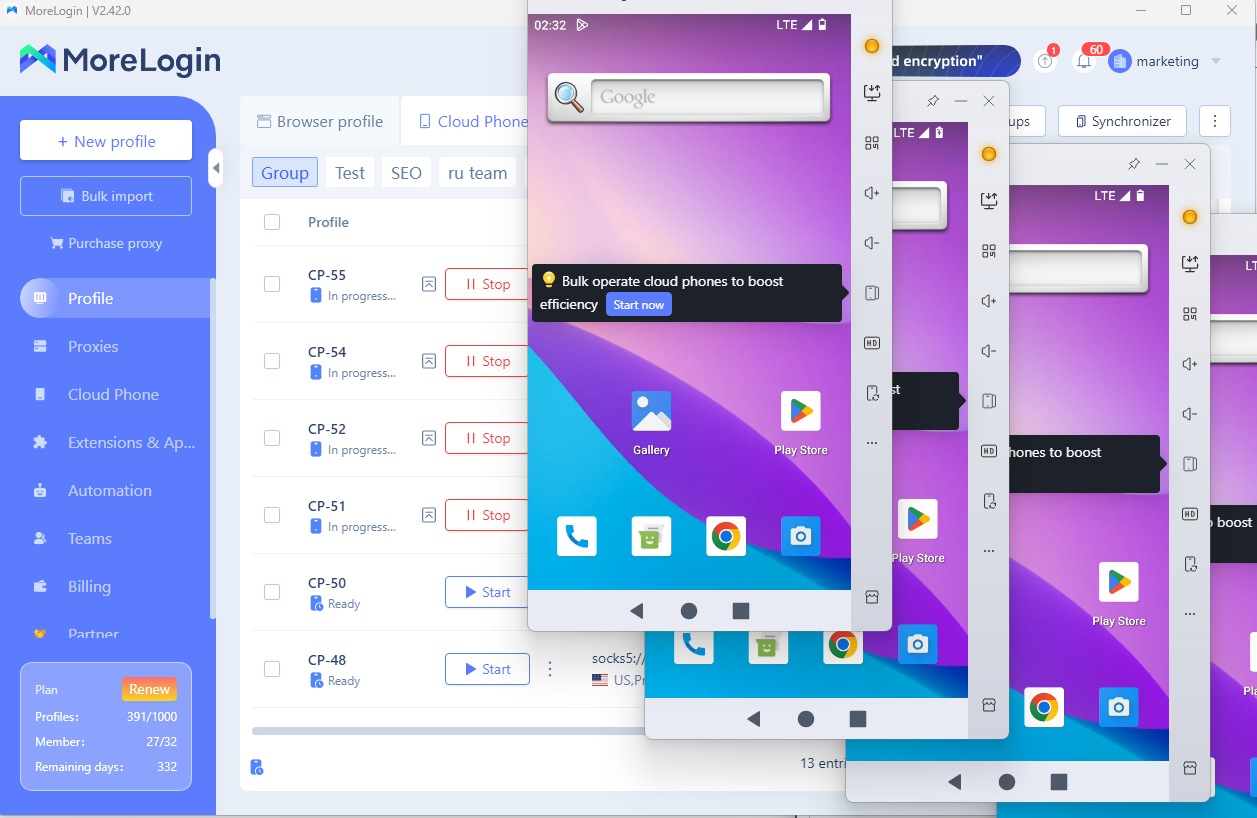
Use Cases: Cross-border e-commerce, multi-platform advertising, social media scaling.
Pros: Stable, scalable, strong anti-ban technology.
Cons: Oriented toward professional operators, not casual entertainment or gaming users.
Backed by Tencent’s powerful cloud ecosystem, Tencent cloud phone provides a stable Android environment in the cloud. Its major advantage is tight integration with Tencent’s gaming ecosystem, serving both personal and enterprise users. It is especially useful for mobile game automation and large-scale multi-instance scenarios.
Use Cases: Game farming, multi-instance use, and domestic Chinese businesses.
Pros: Reliable infrastructure, broad ecosystem compatibility.
Cons: Geared more toward gaming, lacks advanced enterprise batch operation features.
Built on NetEase’s cloud gaming platform, this product emphasizes low latency and high-quality graphics. Despite the gaming label, it also supports application multi-instance usage and testing, combining emulation with cloud computing capabilities.
Use Cases: Primarily gaming, with secondary testing and multi-app scenarios.
Pros: Strong performance optimization, handles high-load gaming smoothly.
Cons: Focused mainly on entertainment, limited enterprise operation support.
Redfinger has strong visibility in Southeast Asia and overseas markets, focusing on international access and multi-region nodes. For businesses that require different regional IPs, it provides flexible options.
Use Cases: Cross-border e-commerce, overseas advertising operations.
Pros: Multi-country nodes, flexible pricing.
Cons: Experience not as refined as enterprise-exclusive products. Weaker support for mainland China users.
As one of the earlier Chinese cloud phone providers, 51 cloud phone mainly serves mobile gamers, emphasizing low-cost automation and farming. It represents a traditional style of cloud phone offering.
Use Cases: Game farming, personal users.
Pros: Low entry cost, affordable pricing.
Cons: Slow technical updates, not suitable for complex business scenarios.
MOMO, based in Taiwan, emphasizes enterprise testing and automation. Unlike many other products aimed at gaming or casual users, it is more oriented toward B2B services.
Use Cases: App testing, automation for enterprises, internal operations.
Pros: Robust professional testing capabilities.
Cons: Limited appeal for individual users, business-focused.
Launched by NetEase, Airtest Cloud is an automation testing platform designed for developers. It supports cloud-based UI automation, compatibility testing, and virtual device simulation. This makes it very different from traditional cloud phones, as it is built primarily for R&D.
Use Cases: App development, automated testing, CI/CD pipelines.
Pros: Professional-grade features, tailored for developers.
Cons: Not built for large-scale account management or operations.
Amazon’s offerings are not traditional cloud phones but rather cloud app streaming and real device testing services. Device Farm, in particular, allows developers to test across hundreds of real Android/iOS devices remotely.
Use Cases: Development, debugging, cross-device validation.
Pros: Global infrastructure, wide range of supported devices.
Cons: Expensive, unsuitable for bulk account operations.
Genymotion is a well-known Android emulator widely used by developers. Its cloud version allows running Android virtual devices in the cloud, making it popular for QA, CI/CD, and automation workflows.
Use Cases: Development teams, continuous integration pipelines.
Pros: Mature developer ecosystem, strong toolchain support.
Cons: Virtual devices only, not real hardware, which makes them easier to detect.
BlueStacks has long been one of the most popular Android emulators. The X version brings its functionality to the cloud, enabling instant play in a browser without installation.
Use Cases: Gaming and entertainment.
Pros: Easy to use, broad global user base.
Cons: Limited to gaming, lacks business-grade features for scaling.
After a deep understanding of different brands of cloud phones, how should different users choose cloud phone systems? Please continue reading.
Individuals / Gamers: Tencent and NetEase cloud phones provide low latency and a smooth experience, perfect for multi-instance gaming. For example, running 24/7 sessions of games like PUBG Mobile or Arena of Valor typically requires a 2-core CPU, 4GB RAM, and 5-10 concurrent instances.
Small Studios / E-commerce: Morelogin cloud phone is the top choice with account isolation, anti-ban, scheduling, and automation. A studio managing 50-100 accounts often needs an 8-core CPU, 16GB RAM, and 30-50 concurrent instances, costing around $50-$100/month. You can learn more about the Morelogin cloud phone for multi-account management.
Enterprises / API Automation / Overseas Marketing: Genymotion and AWS suit large-scale testing and automation. For example, global ad agencies often require 100+ concurrent devices, with monthly budgets from $500-$2000.
A cloud phone is an Android-based virtual phone hosted in the cloud, not a physical device. Unlike traditional smartphones, cloud phones allow users to run apps, games, and automation tasks remotely without owning actual hardware. They operate through cloud infrastructure, providing benefits like scalability, cost-effectiveness, and the ability to manage multiple instances simultaneously. Cloud phones are ideal for businesses needing multi-account operations, automated advertising campaigns, and cross-border e-commerce management.
Modern cloud phone systems like MoreLogin implement robust security features including account isolation, anti-detection mechanisms, and anti-ban technology. These platforms use real Android devices rather than emulators, making them harder to detect and block. Key security features include geo-IP binding for regional targeting, encrypted connections, and dedicated anti-fingerprinting systems that protect your accounts from platform restrictions. For businesses managing 50-500 accounts simultaneously, enterprise-grade cloud phones offer bank-level security protocols and 99.9% uptime guarantees.
Cloud phone pricing typically follows flexible models based on usage time and resources. MoreLogin, for example, offers transparent pricing billed by the minute with a monthly cap of $28 per device, making it significantly more cost-effective than purchasing hundreds of physical smartphones. Most providers offer tiered plans ranging from basic setups (2-core CPU, 4GB RAM for ~$50/month) to enterprise configurations (100+ concurrent devices for $500-2000/month). Compared to buying physical hardware, cloud phones eliminate upfront costs, maintenance expenses, and device replacement cycles while providing instant scalability and 24/7 remote access.
The Top 10 cloud phone systems in 2026 each serve unique needs. Gamers favor Tencent and NetEase, developers lean towards Genymotion and AWS, while e-commerce and marketing teams find Morelogin the most efficient.
With strong performance, automation, and anti-detection features,Morelogin cloud phone stands out. If you want to expand operations securely and efficiently, considerMorelogin cloud phone.
 EN
EN